
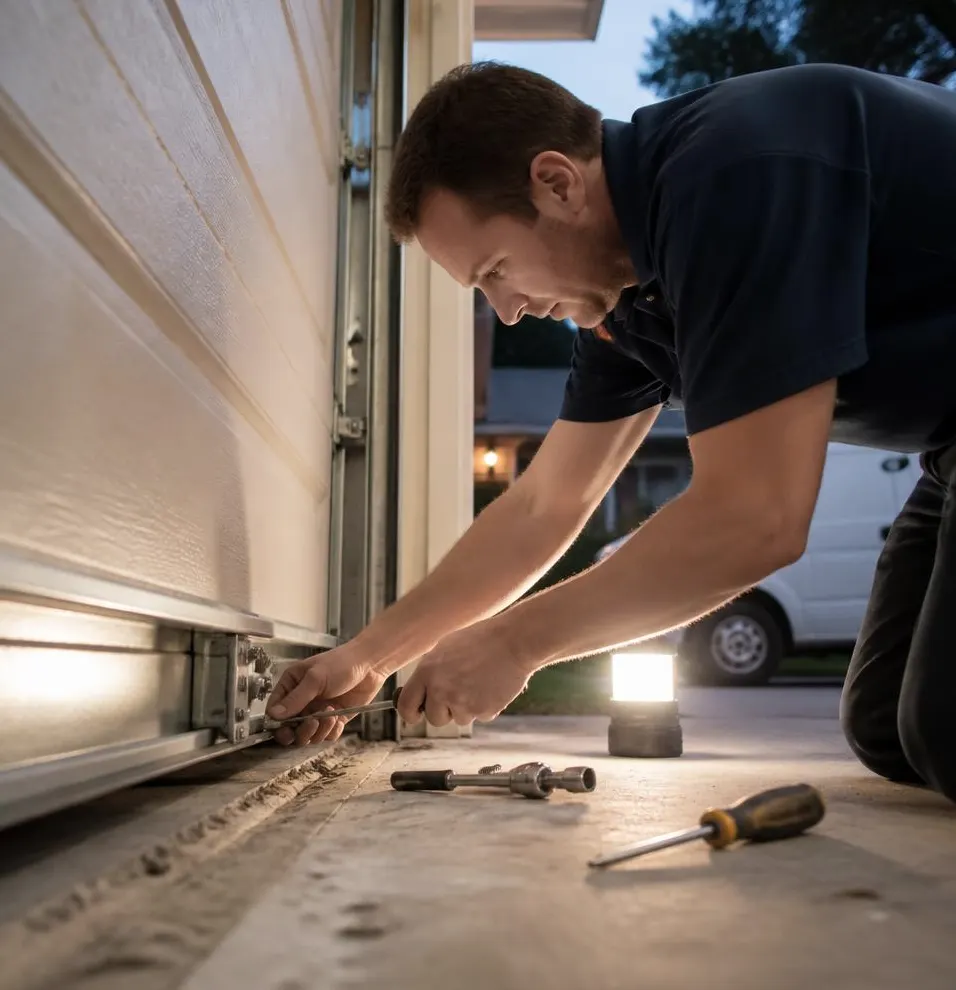
The Short Answer First
Nine times out of ten, a garage door that starts closing and then reverses is being stopped by its safety sensors, not a broken part. The exceptions are a door that won't move at all when you press the button, a door that reverses at the exact same spot every time regardless of sensors, or a door that's visibly crooked in the track. Those point to limit settings, an obstruction, or a mechanical problem instead. Knowing which situation you're in saves time before a technician ever shows up.
What You're Actually Seeing
Garage doors don't just "malfunction" in one generic way. The specific behavior narrows down the cause fast:
- Closes a few inches, then reverses immediately — almost always the safety sensors near the floor.
- Closes most of the way, then reverses near the ground — often a limit switch setting or something blocking the sensor beam.
- Won't move at all when you press the wall switch or remote — could be power, the remote itself, or a stuck mechanical part.
- Moves but is visibly crooked, grinding, or one side lags — off-track rollers or a cable/spring issue, not the electronics.
- Opener light blinks a set number of times — most openers use blink codes to point to the sensors or the force setting; check your owner's manual or the sticker on the opener head.
The Causes, in the Order a Technician Checks Them
1. Safety Sensors (Photo Eyes)
These are the two small boxes mounted a few inches off the ground on each side of the door, connected by an invisible infrared beam. If anything breaks that beam, or if the sensors aren't pointed at each other, the opener assumes something is in the way and reverses the door as a safety measure. In this area, the usual culprits are a spider web across the lens, condensation from humidity fogging the sensor, direct afternoon sun hitting the receiver at a low angle, or a bracket that's been bumped out of alignment. The fix is simple: wipe both lenses clean, confirm both status lights are solid (not blinking), and nudge the brackets until the lights stay steady. If the wiring has been nicked or corroded from years near salt air, the sensor may need to be rewired or replaced outright.
2. Limit Switch / Travel Settings
Every opener is programmed to know how far the door should travel before it's considered "closed." These settings can drift over time, especially with the temperature and humidity swings common here, which cause metal tracks to expand and contract slightly. If the limit is set wrong, the door may think it's hit the floor when it hasn't, or hit resistance it interprets as an obstruction. Resetting the limit switch is usually a quick adjustment on the opener itself, but if it keeps drifting, that's often a sign the track or door weight has changed and needs a closer look.
3. Obstructions and Track Debris
Sand, leaves, and grit kicked up by afternoon storms can build up in the track or around the sensor area without being obvious. A technician checks the full track length and sensor zone for anything blocking movement or the beam before assuming it's electronic.
4. Rollers and Track Alignment
Rollers that are worn, bent, or sitting in a track that's slightly bowed will cause binding partway through the cycle, which some openers misread as resistance and reverse accordingly. Wood or composite panels that have swollen from humidity can also bind against the track. This is where off-track repair comes in — realigning the track, replacing worn rollers, and confirming the door glides smoothly through its full range.
5. Spring Tension and Balance
If the springs have weakened, the opener has to work harder to lift and lower the door, which can trip the built-in force sensor and cause a reversal, especially on the way down. Springs here take a beating from heat and humidity cycling, and a door that feels heavier than usual when lifted by hand (with the opener disconnected) is a sign the springs are on their way out. This isn't a DIY fix — spring tension is dangerous to adjust without the right tools and training.
6. Opener Logic Board or Force Settings
If everything above checks out, the issue may be the opener's internal force setting (too sensitive, so it reverses too easily) or, less commonly, a logic board that's degrading. Power surges during storm season can shorten the life of these boards, so if your opener is older and has been through a few bad storms, this moves up the list.
If the Door Won't Close at All
Rule out the simple stuff first: dead remote batteries, a breaker that's tripped, or a wall switch that's stuck. After that, check whether the wall switch and remote both fail the same way — if only one works, it's likely the remote or switch itself, not the opener. Chewed wiring from pests in the garage is also worth a look, particularly in older installs.
When to Call Clearwater Door & Opener
If you've checked the sensors and the door still won't behave, it's time for a second set of eyes. We regularly handle Off Track Door Repair for doors binding or grinding partway through their cycle, and Garage Door Spring Repair for doors that have gotten noticeably heavier or are triggering force reversals. A Garage Door Maintenance & Tune-Up is also worth scheduling if your opener is older or has been through a few storm seasons — we'll check the sensors, limit settings, track alignment, and spring tension in one visit so small issues don't turn into a door that won't close at all.
If your garage door in Clearwater, FL is reversing, stalling, or refusing to close, give Clearwater Door & Opener a call. We'll diagnose it right the first time and get your door back to closing the way it should.